Exactly, two years ago, in the February of 2024, two major assignments came my way. I was assigned to an onsite project in Pune, and I was assigned into a matrimonial relationship. Initially I was excited for both, however very soon one of the assignments started to haunt my waking world. Through the ordeal, I learned an important lesson. I learned that humans are inventive creatures; we have the power of imagination and ingenuity through which we have the power to change what we do not like. I don’t dislike my marital assignment; I just hate being in Pune.
Salutation:
27 February 2024 was the day I came to Pune for the very first time in my life. I went to Hinjewadi in the morning to report and then during afternoon I was travelling to Yerawada from Hinjewadi along with a colleague from Solapur, to collect my laptop. In between our journey, near Manapa, I saw Mula Mutha river. I have always been good with geography, and I was trained in geology in my college, hence I know a river when I see one. After seeing Mula Mutha river, I exclaimed, “Wow a river!” to which my colleague answered, “Nala hai re!” I knew he was joking about the river being a drainage due to its terrible situation, yet that was the cream of my stay in Pune. Over the course of a year, I tried making Pune my home, yet it was of no use. If I took public transport, my head would hurt due to jumping buses on the crumbling roads. If I drove a rental scotty, I would get sudden terrible jerks due to the same roads. If I walk, I am constantly worried that something is going to hit me on the narrow roads or something might fall from the metro construction site. My fears are not irrational, I have seen people dying in the narrow road due to half constructed metro pillars and moving construction vehicles. I am so much terrified of Pune that I actually loved being in Bengaluru, and I want to go back there. It’s as if making Hitler the chief guest because he is better than the Devil. I also feel guilty staying in Pune, because my kind, the IT service personals, are the reason, a beautiful city situated on one of the oldest mountain ranges in the world is a living hell.
Since I failed to adjust to Pune, I did the next best thing, that is to get work from home and go back home. I availed work from home from an organization, my client, which has a very strict work from office policy, which is 3 days in office week per week while only two weeks of continuous work from home in a year. Out of last 2 years, I have stayed in Pune, only for 8 months including this month. When I look back, even I am surprised at the data. I realized the power of human ingenuity and persuasion. I would just think of the reason why it was important to get work from home approval, I would practice asking for approval and then I would execute with 100 percent strike rate. I never failed in availing work from home. I am again going back to Ranchi. coming Monday.
While work from home is a lifeline to survive, it is not enough to grow, hence when I completed my minimum serving period for change in project assignment, I asked for what I truly deserve, I asked for a project change, and guess what, I didn’t get it. Instead, I got a subtle blackmail that my annual appraisal will be affected if I keep asking for what I deserve.
Did the blackmailing deter me? Off course it did, I need good rating to get the next assignment however it didn’t crush my will and once the ratings were locked, I ran away to Bengaluru, and guess what, that didn’t work out either. I am still here, but I did get to stay in Bengaluru for 4 weeks which was enough to prove that I am not crazy for seeking a way out of Pune. And the silver lining to this fiasco was that I have a last working day in my current assignment and hence in a couple of months, I will be (fingers crossed) Pune free.
This whole comical saga was a blessing in disguise for me. It worked to increase my confidence in my ability to influence my life and reaffirms that our human brain is mighty powerful, it is full of ideas to change our situation. I now believe that there is no such thing as being helpless, if we want a change, it is within us to make that happen. What also helped we was my work ethics; people trusted me to complete my work unsupervised. I am also very good at making one to one relation, since I have very good relationship with my managers, there was no repercussion for my bold move. Yet the major credit goes to my will power, the will to affect my situation and not feal helpless.
Dear audience, if you ever feel helpless, maybe because you have been single for a very long time or been in a dead relationship forever. Maybe it’s the job where you are vegetating or that home you always wanted to buy but couldn’t, just close your eyes and repeat, you are not helpless, tap into your will power and believe that you have the power to change.
Through this chapter, I will teach you to be slight comfortable with Linux GUI and Terminal. I will cover basic command like ls, cp, mv, cd etc. show that you can draw parallel to GUI based action to command based action.
GNOME Desktop Environment(Linux)
Getting around in your GUI is very straight forward. You can click show apps to see installed apps. You get a lot of utilities while installing Ubuntu such as libre office, calculator etc. and if you need more apps, go to App Center and browse for apps. For example, if you require postman which is a tool for API testing and verification, you get the option to download it. You can choose to explore under different sections. Steam is also available for Ubuntu, if you are a gaming fan and the creator of Steam is Canonical, the company behind Ubuntu.
By clicking on the right top corner, you can get direct access to Wi-Fi, Bluetooth, screenshot etc. Click on settings to adjust your computer preference, for example, changing default apps.
The Terminal
While, GUI is good for regular desktop usage, the power of a Linux/Unix system comes from its terminal which offers extensive tools to take full advantage of the bare metal processors. To open a terminal in your Ubuntu System, you can either search for it or just type Ctrl+Alt+t ; which opens a gnome terminal in your system.
By default, you land into your home directory. You can verify that by running pwd command (type pwd in terminal and press enter). You can run ls command to list the directory. To change directory, you can use cd target_directory_name (eg. cd Documents). Whatever you type in the terminal is case sensitive, something to keep in mind. Additionally, you can use tab for auto completion, or tab tab for auto suggestion. Using cd as is, will always move you to your home directory.
Relative vs Absolute Path
Since we are just starting, I won’t burden you with the details of Linux file systems, but allow me to tell you just this much, everything starts from / (known as root directory). The output of pwd command is /home/alok, so in a way it is implying that inside root (/) there is home directory and inside home there is alok directory. If I do ls. I can see other directories like Downloads, Destop etc. If I am present in my home directory (/home/alok) and I want to go to a subdirectory Desktop, I can do that in two ways:
Using relative path: cd Desktop
Using absolute path: cd /home/alok/Desktop
Once I am inside Desktop directory and I decided to move to Downloads directory, I can do that again in two ways:
Using relative path: cd ../Downloads
Using absolute path: cd /home/alok/Downloads
.. (Double dots) is a notation for parent directory while . (single dot) is the notation for current directory.
Absolute path should be easier to understand if you understand that every directory can be traced from the root. To make sense of relative path you can try running ls ../.. and see what the output is.
If you feel lost, don’t forget to do pwd to check your current directory. You can get the same information in your prompt text if it set correctly.
Date with Who?
If you are in terminal and doesn’t have access to GUI (maybe because, you ssh into the machine or you are in multi-user.target), in order to keep track of the time, you can use date command. The output of the date command will be human readable date and time along with the time zone.
If you want to check the logged username, run whoami. The output will be a simple print of username.
If you want to run something akin to Hello World program, then do echo “Hello World” .
It’s a wrap
Alright then, in this blog I tried to make you familiar with your GNU/Linux laptop. We started our long journey of Linux shell commands (what is shell? We shall know soon.) Let me list the commands we have learned so far:
pwd (Print the working direcory)
ls (list the content of the working directory)
cd (change to a directory )
whoami (Prints the username)
echo “Hello World” (Prints Hello World in the terminal)
In the next blog, I will go deeper into the known commands, and I will teach you how to get help and documentation, see you then.
My first encounter with Unix like command environment was in college computer lab. I was awestruck by a completely different way of using computers, but it was 6 years later that I became fully fledged Unix / Linux user. My first laptop crashed due to overhitting and coincidently, just 2 months later I was inducted into a project where the ETL jobs were scheduled on a proprietary Unix system. I was able to use my laptop only in windows recovery mode and hence I got an idea to run a lightweight 32bit Ubuntu on my laptop. This was a game changer for me, not only I loved Ubuntu, but I also got a free terminal to practice Linux commands, VIM etc. which was directly beneficial to me in my work, Fast forward to today, I have a Dell G15 (32 GB RAM and 20 Threads Processor) running Ubuntu, while my old HP laptop (8GB RAM and 4 Thread Processor) is running Arch Linux.
I opted for and cleared the certification examination of Red Hat Certified System Administrator, in order to understand my laptop deeper which alleviated any fear of unstable system though to be honest, Linux is the most stable operating system. Our internet works on Linux System (remember the web links have forward slash, eg. amazon.in/gp/css/order-history); Android uses Linux kernel; Super Computers run Linux – All Hail Linux – need I go any further.
The Secure System
I am running, Arch Linux in my laptop and I have hosted it like a personal server which I can connect to from office or travel, to maybe run Apache Spark or something else. I don’t have a static IP, I just check my public IP to connect to my server, and I have opened port forwarding (22 on my Network to 22 on my Arch Linux), I didn’t know this, but it’s pretty insecure since 22 is a well-known SSH port, hence there were tens of attempt daily to hack onto my arch Linux which I got to know recently. I analyzed my logs and evidently there was zero success on my system. Despite thousands of attempts over six months, no one could hack into my system, all thanks to the default configuration of SSH-Server. I have made it more secure now and even changed the port mapping and since then there has been zero attempt, yet I am so proud that my system in its default state was able to fend of all attacks.
The Objective of this Series
While I was preparing for RHCSA exam, I realized that a lot of learning material for Linux is closely guarded which is a direct contradiction of Open Principal, Linux follows. Additionally, I felt bad that people teaching Linux are not running Linux themselves. Hence, I not only want to teach Linux but also wants to inspire folks to adopt Linux (unless they are using MAC), and a biproduct of these teachings can be a successful attempt to Red Hat or other system administration examinations.
The Course Outline
Basic Linux Commands.
Linux Utility Commands.
File Management.
Process Management.
Storage Management.
Software Management.
Installing Linux
While there are many flavors of Linux available, the top two option I would suggest for beginners are:
1. Ubuntu
Ubuntu by canonical is designed for easy installation and desktop usage. Additionally, you get free Pro Subscription which entitled you to get support in case of issue. Download the installable ISO from Download Ubuntu Desktop | Ubuntu.
2. Red Hat Enterprise Linux
Red hat is widely used and hence you get a lot of software’s through Red Hat repos. You need to register your RHEL to download software’s through dnf command. Get your installable from Red Hat Developers | Red Hat Developer site after registering.
Installation General Steps
Get hold of a bootable USB device, through apps like Rufus. On a linux machine, you can do the same yourself using dd command dd if=/path_to/osfile.iso of=/dev/sdx bs=4M where /dev/sdx is the USB device name, can be looked up by lsblk command (I am going to cover this later), but my point here is, you don’t need anything external as the tool is built into your linux system and it goes for a lot of things.
Ensure that secure boot is off then go to boot menu (usually pressing esc, f9, f11 or f12 works, check online for your own computer), and boot through the USB device created in step one.
The bootable USB device starts a Linux System, which also installs Linux on the computer HDD/SSD. Installer programs are fairly straightforward, and it may take some time (up to 20-30 minutes for the installation to finish). Once installation is done, the installer will ask you to remove the boot device and restart. Once you do that, Linux Kernel will be loaded from your computer’s hard drive (or SSD).
Boot sequence is something you may have to check if you don’t see your Linux loading. It can be accessed through the same boot menu and ensure that your Linux is on top of that so that it automatically loads, it is something to note though, likely it won’t be an issue.
Finally, there are tons of videos online, check it out for installation process to ensure that you are following the instruction correctly. Don’t forget to Back up your data, because installation will wipe out your disk clean.
Final Thoughts
Stick with me, I will try to do my best teaching and recording the sessions. I will run the commands on Bare Matel Ubuntu Instance or a Virtual RHEL instance. I won’t cover any Unix specific concept since my focus is on Linux. I am also not going to start a history session however if you feel like you need to know a bit about Linux origin story, the following video is one of the best on YouTube: https://youtu.be/obJOwEy62bk?si=81S26Pn5kiVBKQRI
I think we are all set for the next blog where I deep dive into the Linux Terminal.
Jinja is a templeting framework built in python which goes beyond simple usage of fstring in python to generate dynamic strings. Quite often than not, we need our string to be populate during runtime, for example a welcome message like, “Hello John” for John and “Hello Jen Doe” for Jen Doe. Programmatically it’s not a complicate operation, one can always concatenate two or more string (same or of different datatypes). In python you can write something like this:
python
name = get_name() #Part of application logic
message = "Hello " + name
print(message)

## Better Approach
message = f"Hello {name}"
print(message)
Using fstring, ensures that as a programmer you don’t have to be worried about concatenating wrong datatype, since in python concatenating a string with int will result into an error. This works well unless you are trying to concatenate large strings , which will be the case for SQL Statements.
DBT
SQL is a powerful way to abstract tabular data which has been saving tons of time and codes while trying to get insights from your data; dbt is going to save even more time since we write a lot of repeated SQL statements. Software Engineers like nothing more than spending their time to save other’s time. Dbt can use Jinja templeting easily to inserts it’s patterns in order to make reusable SQL statements and I am going to show you how.
Jinja with DBT
Referencing a Source or another Model
In SQL we often need to query one or more tables to create a view or another table and more often then not, a lot of complicated transformations are required, let me show you an example.
with base as
(SELECT idv, timestampv, attr1, attr2
FROM db.schema.customers),

base_with_rank as
(
SELECT idv, timestampv, attr1, attr2, ROW_NUMBER() OVER (PARTITION BY idv ORDER BY timestampv desc) as rn
)

SELECT idv, timestampv, attr1, attr2
FROM base_with_rank where rn = 1;
In this case we are interested in the latest idv for one to many join, as this could be an append only data model, but the final code would explode with more business transformation and joins.
In such cases, having one query with layers of CTEs is inefficient and harder to maintain. You can create create temp views though , in which case maintaining many objects and it’s references is going to be a challenge. With dbt, we can create separate models for upstream logic, and refer that in your main model.
SELECT idv, timestampv, attr1, attr2
FROM {{ ref('base_with_rank') }} where rn = 1
In this case, base_with_rank is the dbt model name, and we are referring it using ‘{{ }}’. Another useful pattern is referencing a source ({{ source(‘source_name’, ‘table_name’) }}) defined in your dbt project.
Conditional Query
While developing, imagine if you want to put a limit or top block, however you don’t want it to be included when the model runs in production, you can do something like below.
SELECT idv, timestampv, attr1, attr2
FROM {{ ref('base_with_rank') }} where rn = 1
{% if this.database != 'your_prod_db' %}
LIMIT 100
{% endif %}
In the query, this.database is used to access the current database, other useful variables are this.schema and this for the current model. {% code here %}, lets you insert flow controls.
Declaring a variable and Looping
We can declare variables using set keyword, Jinja supports, numbers, strings, list and map.
{% set table_details = {"sys_log": "logv", "tmp_log": "tempv", "boot_log" : "blog"} %}

{% for k,v in table_details.items() %}
SELECT {{ v }} from {{ k }}
{% if not loop.last %}
UNION ALL
{% endif %}
{% endfor %}


-- SQL Compilation of above
SELECT logv from sys_log

UNION ALL

SELECT tempv from tmp_log

UNION ALL

SELECT blog from boot_log
With looping, we can save yourselves from writing tons of repeated codes especially in case of union and case statements. loop.last pattern allows me to write a separate logic for the end (useful in case of comma or keywords like union). Just like map, we can loop over a list.
Miscellaneous Patterns
-- To stop additional lines use minus sign
{%- your logic -%}

-- To put comment
{#
This is a comment and it won't be rendered.
#}

-- else with if
{% set env = 'dev' %}
{% set time = 10 %}
{%- if env == 'dev' and time < 10 -%}
A logic
{%- elif env == 'dev' and time >= 10 -%}
A different logic
{%- else -%}
This one if nothing else
{%- endif -%}
Conclusion
Use Jinja in your dbt code to make your query compact and modular. If you come from SQL background and new to dbt, these pattern will help you identify SQL from the dbt code. Remember, everything is compiled into SQL hence understanding Jinja will help you understand the final SQL that will be executed on your data platform.
During the month of February, this year (2025), I went to Puri with my family. It was one of the pleasant experiences of my life if not the best experience. The trip was packed with cultural experiences, beach experiences, historical experiences and a lot more. A trip like this is not only refreshing but also enlightening towards our golden heritage.
The Plan
Puri is situated in the State of Orissa, in the surreal east coast of India. Since I live in central east of India, accessing Puri was rather easier for me. It was just an overnight journey via train hence, a prime location for our probable trip. Since it is a well-travelled destination, it is rather easy to book hotel online. We also booked a whole day trip to Chilika Lake, which is India’s largest lagoon. Booking the lake trip online through state government website was cheaper and convenient. With just this much preparation our happy trip began.
Lessons Learned
There is still cold in February where I live but when we entered Puri, it was evident that there is no cold, rather the fierce summer was already there. We arrived in the morning and after checking into our hotel and renting a Honda Activa scotty we started right away for the iconic Jaganath Temple. We knew it would be crowded, we just didn’t know how much on a Sunday. It was mighty crowded, and standing in the queue was made worse by the heat and the humidity. There was some respite from mechanical humidifier and fans, but it was not enough. The situation was tough but there was no lack of resolve in us especially considering the mighty importance of the temple we were in. We stayed in the queue for hours and were able to visit the gods. We entered in the queue around 10:30 AM and we came out around 6:00 PM, tired but satisfied with our mission accomplished. We returned to the same temple twice during the later part of our trip. Once in the evening and once in the early morning (4:30 AM). There was hardly any queue in the evening, and we were towards the head of the queue during our morning trip. As a result, during both these occasions, we had an easier time visiting the gods. It was a lesson learned for our future Puri trips: either visit the Puri Jagannath Temple in the evening or early morning.
Seafood and the Beaches
We were fascinated by the options of sea food available as street food in Puri. We wasted no time in jumping into some exotic sea foods which are generally not available in the place where we live. We started with deep fried crabs and tiger shrimps, there were the options of saltwater fishes such as pomfret, tuna and more. We started our beach adventure from the Puri beach, which was rather crowded though on a positive side, there were many street food options there. Niladri beach (around 4 kms from the Puri beach) was a relaxing beach where we went in the morning. There were no shacks there, so we mostly walked. I love water; hence it was very satisfying experience for me.
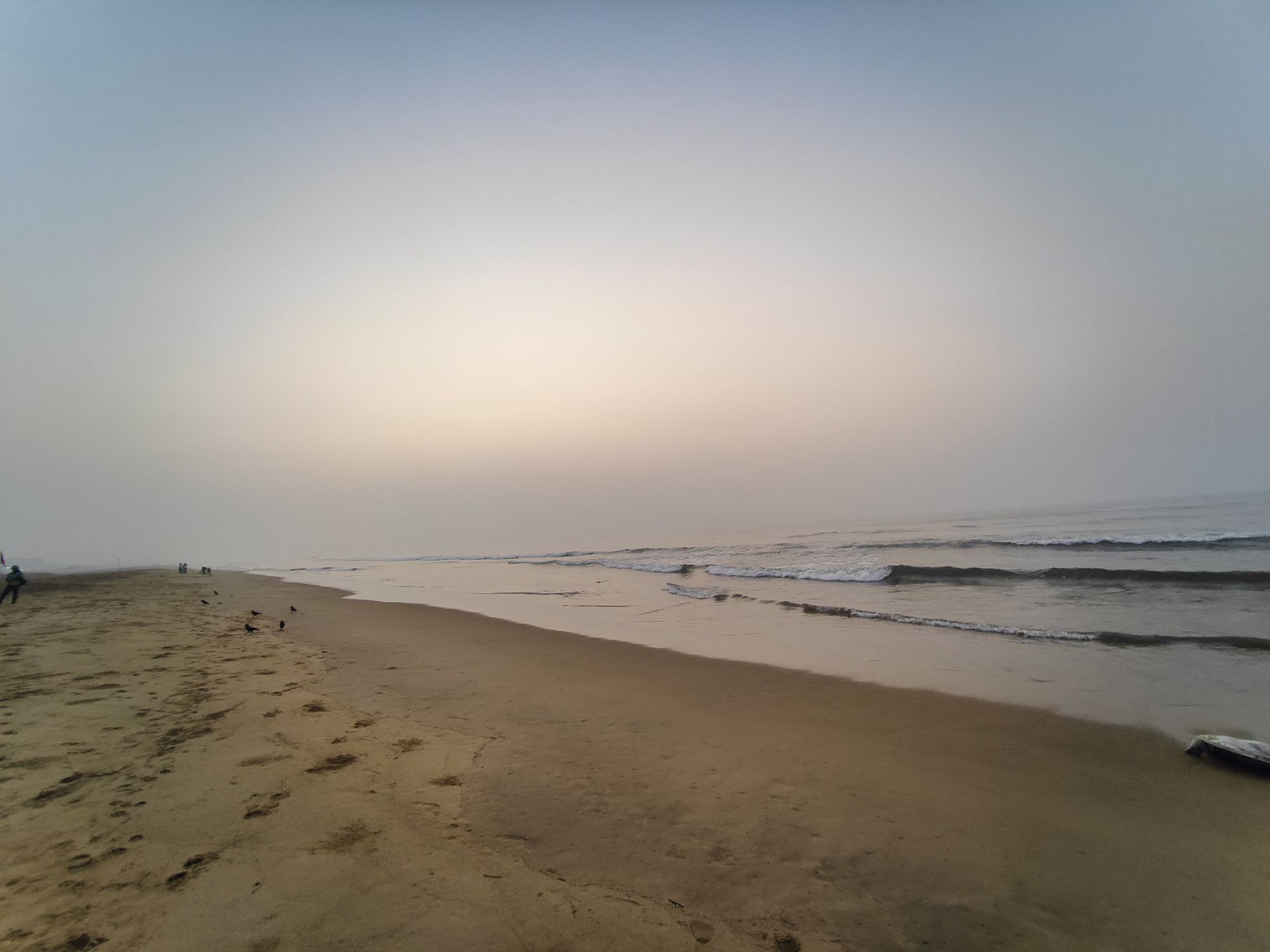
Niladri Beach, Puri
Chilika Lake
I kept a whole day for Chilika Lake which is huge. We had booked the trip online through Orrisa Government’s tourism website. Bus and boat trip was included in the package. We had to board the bus around 6 in the morning at Panthnivas Puri (One can book offline, the same package from here). There was a stop for breakfast before boating and a stop for lunch after boating. The boat ride was for more than 3 hours in which we saw majestic lake, sea birds and dolphins. We had a stop on a beautiful island. Visiting Chilika through the package was significantly cheaper and safer than a private tour. The trip ended with a delicious fish lunch made with the local recipe.
Chilika Lake, Boat Landing, Satpada
An Island with Bay of Bengal to the East and Chilika Lake to the West
Konark Sun Temple
Our final expedition was to Konark Sun Temple, a 13th century UNESCO world heritage site. A site around 40km from Puri which was easily accessible through our rental scotty. I was amazed at these ancient and yet intact sites. There was a beach called Chandrabhaga beach in Konark which is worth visiting. The path to Konark leads through a forest and driving though it was an exhilarating experience.
Disappointment
While the trip was satisfying, there were some disturbing elements to it and to be fair to the place, those are human size disappointments. The crowding and garbage at Puri Beach, plastic bags at beaches in and around Chilika Lake is truly disheartening and it makes me question if we really deserve these nature’s gems. On the island in Chilika Lake, there is no human population whatsoever, so all the plastic garbage left behind by the tourists will hardly be cleaned and hence it would keep accumulating there until this heaven turns into a hell. It would be nothing but a taste of our Karma if in future Puri or any other tourist place become garbage dumbs and thus denying us the beauty that nature has bestowed upon us.
A Final Remark
India is full of places which are nothing sort of heaven on Earth and Puri is one of such places. There are many places in Bhubaneshwar (the capital city of the state) which we had to miss due to heat and time crunch which I would defiantly want to explore in future, till then I will treasure the time I spend in the temple, in the beaches, on the boat in and around Puri for my wonderful trip to the Hindu Heritage land.
One day, not long ago, I saw a group of MBA students coming out of an insignificant Private College in Pune. The sight was rather painful for me to watch because it reminded me of the failing state of our Education System. I suddenly realized that there is a clear similarity between these educational Institutions and religious institutions, for both provide an oversimplified version of a higher truth.
Many MBA colleges, along with other coaching institutions, work on the promise of “Job by mere Study”. These institutions, which broadly include coaching institutes for difficult examinations or coaching for direct jobs in the Government Sector (such as Banking or Civil services), the Private Sector, are highly focused on clearing the examination hurdle by means of study rather than teaching to produce entrepreneurs who can build businesses. As a result, many of these institutes are continuously producing pupils with few marketable skills, and hence more prone to being at a disadvantage due to the ever-changing nature of the market economy, which hardly gives a damn about bookish knowledge and GPAs. Yet many people line up to be part of such institutions, and this mentality is quite similar to the people’s affinity towards religious institutions. A lot of humans don’t care about the true answer; they just need a simple, believable answer.
Religious institutions focus on a single isolated truth while the rest is ignored, like believing that this god sacrificed for you, or believing that praying is the answer to all your problems, or just chanting his name, to make things work for you. These steps may sometimes work like placebo drugs, but the same institutions won’t focus on all the lies they have propagated over the years, such as Earth being the center of the universe or evolution being fraudulent. If they were wrong then, how could they be correct now? My analytical and procedural brain doesn’t buy such unprovable fables, and yet the business for such institutions is booming. In today’s time, people claiming to be the men of gods have a higher earning potential than skilled entrepreneurs. For the masses, this business model works because it relieves them of responsibility; they only need to hold on to one belief or one lie.
The higher truth is always anything but simple. In order to develop marketable skills, one needs to understand current technologies, consumer behaviors, successful businesses, domain knowledge (e.g., Healthcare, Retail, Banking, etc.), and more. One needs to be excellent at negotiation, communication, and conflict resolution. One has to be skilled at sales and marketing, which in turn requires an understanding of human behavior. All of these skills can only be learned through practice in the real world, which many coaching businesses ignore. What is actually taught through books is more graspable to the pupils, which leads them to make over-simplified assumptions that bookish knowledge will get them a job. A few cares about the placement data and base rate. I personally know many folks who have completed their education and are currently doing even more study to get a job. What kind of society are we going to create if key tasks are handed out to people with little practical knowledge? The magic of producing food and resources through book reading is a mere illusion and not real magic.
Similarly, understanding god and the nature of the Universe is never simple. With the advent of modern science, the analysis of gods transcends the realm of logic and ethics and goes into the world of quantum physics and molecular biology. Creation, previously thought to be a god’s work, is now performed by scientists in laboratories. These truths are simply ignored by the proprietors and consumers of these gods’ businesses all over the world. The simple critical thinking in the direction of analyzing one’s god will free them from the senseless actions and appreciate the true value of culture.
The higher truth may be difficult to understand, and it is very well possible that we may never understand it through our ephemeral life, and yet the quest to understand it brings freedom which is otherwise unattainable. By conforming to a narrow truth, one can only achieve illusory peace, which is yet not the worst outcome of this approach. The worst is the creation of mindless followers who are subservient to the whims of their political or religious master. Simplified truths give comfort. The higher truth gives freedom. We must choose which we value more. The choice, at least, is simple: be a puppet or critically evaluate.
I am often stuck on some problem in my work as a software developer, while other times I am unable to think of a topic to write about on my blog. In such moments, I feel the need for a thinking cap. Recently, I realized that I had the thinking cap all along and not just me: you, he, she, they; we all have it and let me tell you how you can effectively use it.
I thought of an idea of satire in February this year, 2025; however, I was able to finish the blog just last week, in mid-July, in the same year. The period between conception and creation was about five months. Five months indeed might be a long time, but if you ask me, I still believe that I am happy to have finally finished it, because for a long time, I was not going anywhere with the story. By the way, if you are interested in the story in question, you can read: Don’t You See, I am Trying to Save You. Suddenly, I had an inspiration last week, and it was clearer to me how my story ends, and with the inspiration, I finished the story.
When the inspiration came, I was wearing a thinking cap, and I didn’t even know about it. I have been using that cap, yet I was not deliberate, and hence, unable to utilize the full capacity of my thinking cap. It took me years to appreciate its powers, and yet it’s not an easy task to be able to reap maximum benefits. Let me break the suspense and introduce you to the thinking cap.
My thinking cap is walking alone, driving, or riding a bicycle. Given that I am not talking to anyone either directly or via my phone, not listening to any music or podcast. In essence, my higher mind is completely free while some other parts of my brain are busy with routine tasks such as ensuring I am not falling off the road or hitting a vehicle next to me or putting my body in any kind of danger. In this state, thoughts flow freely. It may appear simple, but it is anything but simple. My brain doesn’t want to work as a result; whenever I am opting for walking, I get a strong urge to listen to any music, podcast, or audiobook. I even get an urge to take all my pending calls, and believe me, I take most of my calls while walking. While driving, there is no option to entertain my brain, yet I do not get a lot of driving opportunities. Nevertheless, if I can tame my mind and not entertain it, I achieve the state where thoughts start inundating me. Our minds crave distraction, but it’s in those quiet, undistracted moments that genius whispers. Yet there is another difficulty other than the difficulty of will power.
Whenever I am in a thinking-cap state by the act of walking, cycling, or driving, I don’t have conscious control over my thoughts. The only thing guaranteed is that there are a lot of them. I remember many times enduring depressing thoughts originating from some trivial incident of wrongdoings, such as a disagreement with a colleague, someone not following a traffic rule, some wrongdoings of the distant past, etc. Sadly, there is no solution to this predicament. The only solution I can think of is to maximize the thinking cap time. Let’s say that on average 25 percent of time, happy and creative times are flowing into my higher mind, then spending ten hours a week will give two and a half hours of creative time which I can translate into good work if I can follow up on the head start, and that is another challenge of the thinking-cap state, the thoughts are ephemeral.
Willpower is essentially required to maximize the creative time, but following up with the creative time is even more important; otherwise, the two and a half hours I calculated earlier would amount to a big zero if I am unable to follow up on my thoughts. It so happens that the thoughts that flow in the thinking-cap state don’t last long and dissipate like a dream sequence. It is highly important to note down creative thoughts. When I had the inspiration last week for closing my satire, I straight away opened my laptop and finished writing; however, it was a coincidence that I was able to use my laptop to write, after walking. It may not be the case, always. To this, I have a solution: note apps. I have downloaded an app that is just there to note down inspirations like these so that I can work on; however, something tells me that even that won’t be sufficient. I have a feeling that if I write it down and don’t look at it again for months, I will lose interest in the inspiration, and it won’t be that appealing to me to drive me to write about it. Hence, a recommendation to self and all, begin the work on your inspiration within twelve hours of achieving it.
Let me summarize the effective ways to use our thinking cap: 1 – Give the thinking-cap state enough time, perform activities like cycling, driving, and walking without any music, podcasts, etc. 2 – Once the inspiration comes, write it down as soon as possible, preferably before you forget all about it. 3 – Start the work on your inspiration within twelve hours of the inception of the idea.
Next time, if you are stuck with a work problem, looking for an idea to draw, write, or compose, or seeking a business idea, try this thinking cap, make effective use of it. Next time you feel stuck at work, in art, or in life; take a walk without your phone. Your best ideas might be waiting at the next corner.
It was a great winter month, but more importantly it was a month of many good news for the people living in the lost village of Kokara in the state of Odisha, India; for finally they have been discovered by concrete road, electricity and the rest of the world. Kokara was cut off from the world when a water stream falling in the lake Chilika changed its direction and flooded the surrounding area though some might say that it was a blessing in disguise for the villagers in Kokara had been spared by war and subversion; and they meet the world in a new and independent India. Since the water stream dried, the village was discovered by the youths of the nearest village who were on the mission to kill boredom and find something delicious to eat.
The first prominent human to visit the village was the collector of Ganjam, the district under which the village was marked. The story of the visit made it into the national newspaper and soon the village was inundated with visitors. The academics came with their never-ending questions; the tourists came for their never-ending curiosity. The visitors brought all kinds of alien and fascinating items: packets of biscuits, juices, cakes and all kind of edibles. The villagers were so pampered by the outsiders that soon most of them fell sick, which was a blessing in disguises because soon they received healthcare, perhaps quicker than any other village in the history of human existence. Roads and electricity followed afterwards. The lost village featured every day in newspaper and on television. There were so many stories about their eating habit, their rituals and customs, their language which was in some way similar to the current language of the region and their amazement at this newfound world beyond their watery borders. This discovery was a boom for newspaper industry because their sale almost doubled since everyone wanted latest news about the lost village and it took almost two months for the newspaper sale to return to normal. Even Kokara was unrecognizable post this duration, because concrete bridge was built to connect it with the mainland, the inner village dirt roads were transformed into the brick road, there was a torrent of incoming motor vehicles which fascinated the youth of the village yet the life of people in that village was still same, fishing and planting but mostly fishing.
When the dust settled and the newspaper stopped talking about it, they came; when the discovery was a mare past memory among the masses, they came; when the number of visitors has dwindled a new unique visitor, man in his late fifties, arrived, not for curiosity or amazement but with a self-proclaimed vital mission in his mind.
The man named John arrived at the village in his long hat and black robe, he had lost most of his hairs and his face was wrinkled with worries of years. He went to the first young man he could find and asked him to gather everyone for he has brought something valuable for all. The young man who was by then used to the amazing eateries and instruments was neither delighted nor disappointed by this encounter since he has nothing more interesting to do, he did what he was told and soon whoever was getting bored gathered under the shade of a Neem tree.
Once old John saw that no more were coming, he went to each person, shook their hand and chanted, “God is merciful!”. People looked at him in amazement for all the crazy things they had witnessed in the last few months, it was a clear winner. “God is merciful”, John continued, “for he dried the river so that I can come and save your souls, you see my good people, you have been under the influence of demons, worshiping it and offering it your prayer while God was an unknown to you, but it’s never too late, you can still renounce your demons and start believing in the God and his son…..”. While some were still trying to make sense of these words, those who were smart enough to follow with John’s words came closer to him, grabbed him by the neck and started pulling him out and they didn’t stop till they were at the bridge. If the reporters would have been around, they would have got their headlines, for it was first recorded instance of violence by the people of Kokara in the known history.
The forceful expulsion of John for demeaning remarks against village culture reached the ears of Saga-ram, the most ancient being in the village. He was unhappy with the incident and he reprimanded the people involved for acting crazy around the crazy.
The village life resumed as usual, there was now a school in the village to teach the young mind, but the arrangements were not like other schools in the region. It was operational only once a week and every month there was a new teacher who would arrive and teach. Teaching was just too important a job to conduct regularly by a few permanent teachers. The youth and the kids were learning to write what they have normally conversed on a regular basis, and kids were specially fascinated. That one day of the week was a day they always looked forward to because it broke the monotony of their normal existence. Even this routine was finally broken by the return of good old John, some five months after his expulsion. He returned with two of his female colleagues and a new teacher. Villagers, still annoyed by John’s last visit were simply looking for some excuse to make the visit more interesting, they were disappointed since all four went straight to the school.
The teacher of the month very happily announced that, John and his colleague would help them teach. They would come every day except one to teach while the weekly visit of a teacher would continue. That day it was mostly about setting things up by the newcomers. The next Day John and his colleagues arrived in the late morning. Kids gathered but there were not as many as there was the day before. Some families were skeptic about this new arrangement while others had too much work to send their kids and teens to study for more than one day of the week. This didn’t bother any of the newcomer. While John sat on a chair, his colleagues, Martha and Agnes started interacting with the kids. They continued teaching the kids alphabets of Odia and English, writing words and sentences and history of India. In the afternoon before ending the education session, John took over the teaching and began his monologue. “Kids! Today I will tell you how the world was created.” He continued, “On the first day, God created the Earth and heaven, and he said let there be light and then there was light. On day two, God separated heaven from Earth, on the third day God created ground and sea and plants. On the fourth day, God created Sun and Moon and on the fifth day …..” “How do you know it was fourth day when there was no Sun?” Asked, Ghungru, the smartest of the class. “God knows everything,” replied John. “On the fifth day, God created fishes and on the sixth day, God created Animals and then he finally created us Humans, on the seventh day, God rested, that is why we don’t work on the seventh day, Sunday.”
“Did God sleep in the night like we do?” “Sure, yes, we are in Gods image, so definitely God worked during the day and slept in the night.” “Did other Gods help this God in the work?” John wanted to say a lot, yet he couldn’t, the direct method of communication was not working. John was after all a smart person. He remembered the raze, a college professor felt during a confrontation with him during one of his roadshows of “Words of God.” The professor was questioning his faith with stupid question, such as how do know that your god isn’t delusional when he taught you that Sun revolves around Earth and John replied that, isn’t it obvious, we do see Sun rise up in the east and set in the west. The professor lost his cool over John post that argument. How can people believe in stupid facts like “Evolution”, “Earth is not the center of the Universe” or “God could be wrong”.
The new routine worked like a clock, and since the folks in the village were now well aware of the calendar, they were able to guess on what day John and his colleagues would not arrive or on which day government teacher would arrive. Sunday was a day of break for John and his team while Wednesday was the day on which the teacher would teach and asses the progress of education of the folks of the village. The village teens and kids were making sound progress in their useless education. All of them, since the time they could speak, had been training in fishing, boating, agriculture, crafting etc. the skills directly translated into visible outcome. They had hard time imagining the usefulness of being able to read some piece of paper, yet they persisted because they understood that in the outside world, one can produce food by reading from a page and they were eager to learn that magic. The classes were not too bad, and they enjoyed the final session of the day which to them was story time. Story of a particular god who created the world, destroyed the world, helped someone, impeded someone else, send messages, send his family members, give different instruction in different stories. Even though weird, stories were fun to listen to. The same fun was not there for John. While the education was going great, he was still unable to show progress to his peers. After a year since he came, there was nothing to show for, forget about being able to convert a villager, he was not able to do any sermon. He tried to organize a few, yet no one showed up except his bored students. He was criticized by his peers for his opening. Once trust is lost, it is difficult to regain was something he heard often from his peers, which he made a note of for his future missions. It was agreed within his organization that John need a helper, someone who could be the new face of their endeavor. Andrew was selected for this job to be the new face of their mission. They also decided to change the tactics and invest more time in understating the current culture of the village which could help in forming strategies in saving the villagers, after all ensuring that the villagers believe in their version of God was of vital importance, even more important than surviving and so they believed.
Andrew was a proactive and pragmatic middle-aged man who loved to converse with people even beyond the realm of faith. He began door to door campaign to understand the current faith of the people. During his visits he would listen and ask questions patiently and he tried his best not to validate their stories against his own stories, which was off course one of the most difficult tasks he had ever undergone, and he proved stronger than John for he didn’t blurt that the people there, were believing in the false stories and what actually happened was part of the book available to him. God was perhaps lazy and couldn’t reach to these people on time to tell the truth, now it is up to people like John or Andrew to correct God’s mistake. Through their stories, Andew got a clear picture. The people of Kokara believed in many deities, but mainly worshiped Sea and the Sun. The manifestation of both were in a shrine under an ancient Peepal tree. They also believed that the stream was a minor deity. The sea held a lot of power over them, it was a source of food, yet it was a cause of destruction; Sun held a special place because in the presence of the Sun, the Sea was calmer.
One day, Andrew came in contact with the village elder, Saga-ram, a man who was over 80 years old and was the sole problem solver of the entire village. He was also the reason for lack luster performance of John, Andrew and company because everyone consulted Saga-ram and Saga-ram never believed in a single word of the John and Andrew, though Andrew was not aware of this passive resistance by village’s most ancient being. Andrew found Saga-ram in the front yard of his home, lost in deep thoughts that only Saga-ram could follow. Andrew reached out to Saga-ram and held his hand and in a loud whisper said, “God is merciful!”. This was the signature greeting of the organization, Andrew, John and others were part of. Saga-ram just listened. After the greetings, Andrew went with basic icebreakers which ranged from “How are you?” to “Do you think it will rain a lot this month?” After the icebreaker, Andrew jumped guns. Andrew: “Do you believe in higher power? Someone who creates controls all of our life and the Universe.” After the pitch, Andrew went silent and patiently waited for Saga-ram to respond. Saga-ram: “I do believe in a power greater than anything else.” Andrew was delighted with this response because every time he has pitched the question to someone else, the response had been vague and close ended. Andrew: “We too believe in a higher power, just one power.” Saga-ram: “Good! good for you.” Andrew was disheartened by that close ended response, still he forced the conversation. Andrew: “Do you know why I am here? I am here because that one true power inspires me to spread its words, it fills me with a purpose to ensure that there is no one in the world who doesn’t believe in that power. That purpose has led me here in this village.” Saga-ram was amused by the monologue, because he understood exactly why this person was bothered to sit with him. Saga-ram: “You want me to believe in a higher power, but I already believe in that, everyone in this village believe in that, you think it is us who ensure that our boats return safely from the sea? No! The higher power ensure that we get back safe and sound.” Andrew was frustrated inside but made a calm demeaner, smiled and thought to himself, this is my chance, I should make my case. Andrew: “You may believe in the higher power, God, but you pray to the devil.” Saga-ram: “What is a devil?” Andrew: “A false god, a trickster.” Saga-ram: “But you said that there is only one higher power!” Andrew: “God is the highest power, he created angels, lesser power than God and devil is one of those lesser powers.” Saga-ram: “And you think that we worship that devil, when we worship the Sea and the Sun.” Andrew: “Yes! Precisely.” Andrew was feeling triumphant, finally someone was getting his message. Though his good feeling was ephemeral. Saga-ram: “Which one? Which one is the devil, the Sea or the Sun.” Andrew: “Devil has many underlings?” Saga-ram: “Like God has angels.” Andrew: “Yes! Precisely.” And Andrew was feeling triumphant again. Saga-ram: “You are very funny, Sir; you say that there is just one higher power and then you bring devil a rival power and then you bring minions of both the higher power. How are you able to believe in such complicated stories, you must be crazy.” Andrew: “You are not being reasonable, don’t you see I am trying to save you.” Saga-ram: “Save me from what?” Andrew: “If you won’t believe in God, devil will take your soul.” Saga-ram: “Why is it bad that the Sea will take me with her.” Andrew: “The hell is not in the sea; it is place of eternal suffering.” Saga-ram didn’t say a word; he remained silent and amused at the fuming face of his visitor. Finally, he asked. Saga-ram: “What do you do?” Andrew: “I am the messenger of god, I save people.” Saga-ram: “No, I mean other than this.” Andrew: “This is what I do, I save people’s soul.” Saga-ram was left bewildered for a moment. It took him some time to compose his thoughts and then he replied. Saga-ram: “I have loved the sea since forever; it is my place of worship and enlightenment, I used to bring food, the fishes from the sea and I have been the best at it. When I grew old, I taught this skill to my children, now they do what I did. We lead a simple life here in the village, but I heard the outside world is far ahead of us, there has been men on the moon we see in the night sky, there are talking machines and in all that you are saying that your only task is to be a crazy and convert others to make more crazies like you. Your life must be very meaningless.” Andrew stayed silent and thought, there is no getting through to these people.
Andrew left the place went to school to his colleges John and others. The last few months has been frustrating for him. Though he was able to deliver his message to the others, there was no outcome. They were unable to convert a single person with all the effort they put overtime and the conversation with Saga-ram was a final blow. Andrew, who was so sure about his new strategy earlier, was then contemplating the reasons behind their lackluster performance. Agnes: “What should we do, next, continue the teachings or leave.” Andrew: “No, we must not lose hope, and regardless, teaching is a service, and we should continue that.” John: “Why do you think, it’s not working out for us.” Andrew: “Ah, well! Whenever I bring the subject of saving their soul after death, they seem to become uninterested in the conversation. As if death is something too far or inconsequential.” John: “Strange! Are they not afraid of death.” Andrew: “They are, they are, however, they seem to be devoid of need to lead a good life after death, and I think I might know why.” John: “Is it because they don’t have afterlife in their cultural belief?” Andrew: “No it’s not that; I think their life is sufficiently fulfilling. They have enough land to build home, they have enough food in terms of fishes and produce, they are even independent for clothing. They have nothing to pray for, nothing to bribe for.” John: “You might be right, Andrew! in that case, I think it’s clear what we must do.” Martha: “What is that brother John!” John: “We must hope and pray to God that their boats return empty handed, their crops fail, and they are marred with diseases. They should suffer in this life so that they long for deliverance in the afterlife and start believing. Then we shall be able to save their soul.” All: “Absolutely.” Andrew: “God must help us here, after all, we are trying to save them.” With that remark, Andrew looked up the sky for any sign of approval and right then it began to rain.
They may enjoy the Feelings of Adventure yet it’s not their Adventure.
These days I am doing a lot of rethinking, and I would credit it to Adam Grant, for his book ‘Think Again’ inspired me. A lot of this rethinking is directed towards the way I live my life. I have always loved and enjoyed a good story, either via books or via moving pictures. Now though, I am trying to analyse my pass-time. I asked one simple question to myself, “What is the one thing the characters in books never seem to do?”
I am doing a lot of reading these days (a lot considering my line of work: Software Developer). The current book that I am reading is by my favorite author Gabriel Garcia Marquez; it’s called “Love in the time of Cholera”. I had listened to the audiobook of the same a long time ago, but I bought the paperback to enjoy more time with my characters. Factually a lot of the incidence in the book is inspired by the love story of the author’s parents. The story of young love who were destined to go separate way only to find their way back in their old age is a gripping plot and a true masterpiece. It’s all well and good, yet the rethinking question is, “What is the one thing the characters in this book never seem to do?” The answer is, they hardly read a book at least not in the foreground of the story. The same is true for any fiction you are reading or any film/tv-series you are watching. The characters are living their life in full while we are living their life, enjoying it vicariously. Can we do better?
If someone reads our life story and, in that story, if we are spending most of our time on couch living vicariously then certainly to the reader of that story our life would appear boring. Reading books or watching movies do give us an escape from reality and it is fruitful against the pressure and torment of real life yet the sense of achievements we receive is not ours but the characters of the story. If a character is well liked by most and they win the day, it is their victory not ours hence in reality we gain no experience, no memory nothing worth sharing by just watching or reading a story. It is definitely not difficult to do most of the stuff that a character is doing. Take a romantic movie for example, we typically see a man and a woman fall in measureless love, the man tries his best to give the woman best of dating experience, either he cooks for her or take her to a restaurant with a nice ambience, he attends to all her needs, he listens to her and more importantly he is always ready to give his all for her sake, while woman is also deeply in love and she smiles which makes the man’s day (It all happen like this till things turns for the worst before returning finally to the best). Can we not do the same to our woman (or man), is it that hard. If you are still missing your significant half, surely you are not going to find them in your book or on your couch, get out, do something, meet people and when you happened to find them, treat them even better than what the best of romantic authors had imagined. What if I am not into romantic books, you say. What do you like the most then?
If you are someone who likes adventure movies, then go for your own adventure. I like adventures, and ever since I have done rethinking, I am looking for my chance to go on trekking or running around one of the prettiest lakes, I have ever seen. I go out and be part of forums (well it’s Toastmaster in my case) where I meet interesting people. Most of the times in stories, the characters travel and rediscover themself. Traveling in these times is one of the easiest activities you can pick with the most rate of return. In the era of train/flight/road connectivity there are many cool destinations ranging from pristine beaches to snowcap mountains at on average ten hours away. If you are truly an indoor person, then there are many indoor activities for you, draw, cook, paint, make pottery etc., these are just suggestive options, sky is truly the limit if you decide to come out your vicarious unliving session. However, I have an easier solution, are you Interested?
We all have a taste, we like certain kind of story, whether it’s romance or comedy or any other genre. There are certain aspects in the story which appeals to us. We can try to implement that aspect in real life wherever possible (try not to be Superman or Kickass). Do whatever you like your favorite character doing. It is that easy, trust me, and don’t forget to be creative.
I love to cook, and I am always inspired by different foods I see in movies or even documentaries. My inspiration often leads me to supermarkets and then to kitchen. I had my first roasted mutton when I saw it on TV. This is really a simple trick to come out of the vicarious life yet the best idea would be to build your base from vicarious experiences and build skyscrapers on that base. I can give the example of science fiction to explain my metaphor. In a good science fiction book, there are many impossible gadgets, mentioned yet numerous kids take those unreal gadgets as challenge and make them real, when they grow old to be scientists. Kindle was built in this century however Star-Trek-The-Original-Series already had a digital book reader like that the last century; they even had cell phones before they were built in real life. There are many scientists and astronauts who are inspired by many books of Arthur C. Clarke. These inventor and scientist didn’t get lost in the vicarious world they entered rather draw inspiration from it. I implore you to do the same if you don’t want your life story to be a boring one liner (He spend most of his life on the couch reading or watching tv). Do we stop reading books and watching moving pictures all together?
I think no, especially when I have made a point that vicarious adventure can be basis for true adventure. However, there must be a balance and definitely more weightages should be given to the real life. Make your own story ninety percent of time while enjoy only ten percent of the time someone else’s story, if this is too much then at least ensure that you are having more real adventure than vicarious one. Being able to listen to stories is a bliss, being able to tell stories is a gift and yet the true mastery of life is to make life better than the best of the stories. Vicarious unliving is when there is victory only in the stories we encounter. The real living is when stories are our own. Vicarious unliving is easy yet boring, real living is difficult yet interesting. My act of writing this article is also part of my rethinking to walk toward real living as I think, act, live and then write about it.
I am not the only one who has loved and has been disappointed, in fact I have been someone who has disappointed my lover/lovers, yet this I must claim to be anything but trivial. My failure of love story is a great tragedy which almost succeeded in breaking me, yet here I am blogging casually about it, I am a rock that has an organic heart.
I loved this girl, let’s call her Sarah (not her real name) for what it felt like eternity, and I could swear that for most part of that eternity, she loved me too. We even got engaged and yet weeks before our marriage, things fell apart. It took me two years and two months to erase her ever-presence in my life.
Our relationship was strained during the months leading up to the marriage, but I always thought that everything will be alright, once we were married, I hadn’t in my wildest dream imagined that there won’t be any marriage and I would be heartbroken, hence when it did happen, I was shocked and broken beyond repair. I couldn’t eat and I couldn’t sleep for at least two weeks. I lost a lot of weight, but the worst part were the nightmares. Every night I would dream of her, if I was lucky enough to fall asleep and I would wake up suddenly from my dreams, troubled as if I have been in a nightmare. Let me not be very modest and outright call them nightmares because even though they were about just normal stuff, her mare presence in them was enough to fill me with pain and despair. Slowly I recovered, on my own, I am too much of a man to go see a therapist. Even though I had recovered, I was still unwilling to let her go.
Throughout our time together, Sarah and I had made tons of memories. We had pictures, she had given me gifts like shirts and a wallet which I was totally unwilling to part with. I even had a piece of cloth from her bridal dress which she gave me so that I can buy groom’s dress using it so that both our dresses are in sync with each other aesthetically. Thanks to google, I was remined of those memories almost every week via google photo’s notifications. I told myself that by keeping those pictures and items with me, I was proving to her that she doesn’t affect me, but honestly, I was just fooling myself. I was so enraged by our separation that I decided to never forgive her.
It took a while, well more like 2 years to realize that what I was doing isn’t healthy. In order to be truly free from the pain of the past I needed to do two things, first I needed to forgive her and second, I had to let her go. Forgiveness doesn’t come naturally to me, but I managed maybe with 90 percent accuracy. I am 100 percent certain that I forgive her 90 percent. After forgiveness, it was time to let her go, forever. I had to treat her as if she were dead, I had to hold a funeral and so I did. 29th day of every month had always been special to us, because on 29th March in this life, I told her that I loved her, and she reciprocated. Hence, I decided that on 29, I will hold the symbolic funeral (which was yesterday: 29 April 2025).
I had to erase all the memories, and it was no easy task, yet I did with utmost dedication. Prior to 29, I compiled all her pics from my various devices and google photos. I named the compilation goodbye_{her_name}. I brought a new wallet. On 29th morning, I finished the compilation, deleted all the pics from everywhere (it went to trash) and zipped the goodbye_{her_name} folder and buried into the drive of my secondary Gmail account (yeah it survives but somewhere where sun doesn’t shine). In Hinduism, when someone dies, we hold 12 days funeral for the dead, we deprive ourselves of good food and comfort and after 12th day there is ceremony in which the dead is let go followed by religious worshipping and then we eat the best of foods available. This symbolizes that while it’s important to show our respect to the dead, it is equally important to value the living. I replicated the same funeral for her, but instead of 12 days, it was for 12 hours. On 29th, I didn’t eat any food, I survived mainly on tea, coffee and water. In the evening, I went to a temple, and before going inside, I threw away the wallet which she had gifted me a long time ago, the wallet had the piece of her bridal dress. I deleted her number and her chats. I emptied the trash which had all her pics and just like that I had finally let her go. Post letting her go, I thanked gods, ordered tasty burgers from Macdonald and ended the full grieving cycle.
It was the day before yesterday and I would be lying if I say that I feel lighter already, however there are a few visible changes, since her pictures are gone, I won’t be notified by google almost every other day. I have few reasons to think about her now. I can say for certain that I am no longer in her grip. I am in control of my life and it’s mine to steer in any direction I want. I am free.
There will be more dreams, and she might pop in some of those dreams, but I strongly believe that when she returns, I would welcome her with all my hearts because her presence would no longer be a nightmare, but a pleasant dream, for the time spend together (minus last 3-4 months) are nothing sort of invaluable experiences that I will cherish forever. By giving her a symbolic funeral I have brought her from my nightmares and into my pleasant dream where she will live until I take my last breath.